This week was the first week of my last year of university. Known as our capstone projects. My peers and I came into this year with no prior information as the course went under construction over the summer.
I came into it with an open mind, ready to tackle my last year of university and to start off with a bang! Having had friends who did their capstones the year before I thought I had a good grasp of the workload and mental load, and based on the explanations given during the first lecture I wasn’t very far off the mark. After the expectations were set and our assignments were explained, we launched into action during small group discussion with prompts as well as activities to help us get started with our first assignment which includes this blog and also the tech demo which will be happening in week three.
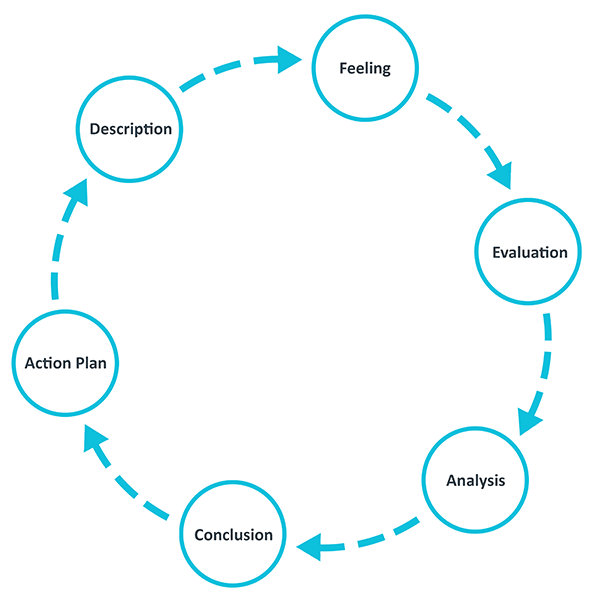
To help me reflect and explain my process, I am going to be using the Gibbs Reflective Cycle (Gibbs, 1988). This model is formed to help users learn and make decisions based on experience (University of Edinburgh, 2024). The model follows Description, Feelings, Evaluation, Analysis, Conclusion and Action Plan as shown below in Figure 1. The first five steps really focus on the experience of the process and step six really involves reflection and future steps taken, and if needed, changes to improve.
University Skills Review
During my time at university, I have dabbled with and experimented with many different skills and software and processes. So technically, I am familiar with many different design tools such as Adobe Photoshop, Blender, Adobe Illustrator, some JavaScript and Python, using different editing software, using physical tools like camera, sound and lighting equipment among many other software and machines. However I don’t feel like I am skilled enough to be teaching others. As I need references and constant help myself whether it is online or from someone more knowledgeable than me. This makes me feel unprepared to showcase my skills. Logically, I understand that this fear stems more from the desire to excel at a task rather than not having any skills to demonstrate or teach.
Ideation For Prototyping
Throughout the class, I thought a lot about what I would like to showcase. My classmates and friends suggested that I demonstrate something related to UX/UI or Adobe software, such as Photoshop or Illustrator, as these align with my strengths and are the areas in which I have the most experience. However, from my perspective, those skills are definitely common within my peers and something that most of them have experience in, and while this isn’t a matter of self-deprecation but rather a realistic perspective, I recognize that some of them will have more advanced skills in this field than I do.
For that reason, I thought perhaps it would be more interesting if I did a relatively new skill that I had learnt during my previous semester, in my DES 241 – Designing with Mixed Realities course: demonstrating the use of Adobe Aero. While I am a beginner and a complete newbie to this software, I found working with it last semester to be very fascinating, and thought that it would be more intriguing than other areas.
Demo Ideation and Development
With Adobe Aero in mind, I started considering and developing in class and while talking with my classmates, an idea started taking form one of my teammates, was considering doing a demo on how to use Blender, we thought it would be interesting if we bounced off one another and I used what she had demonstrated in Adobe Aero to create an MR space. While getting feedback from our lecturer, he highlighted that while it is a nice concept, working off of each other’s project would be hard as I would have to wait for her to complete her work, stressing me out in the meantime, and would also rush her, pressuring her as well. I then thought about perhaps utilising some of the free and readily available material might be the best idea, as my demo was not focused on the model creation aspect but rather how to use them in Aero.
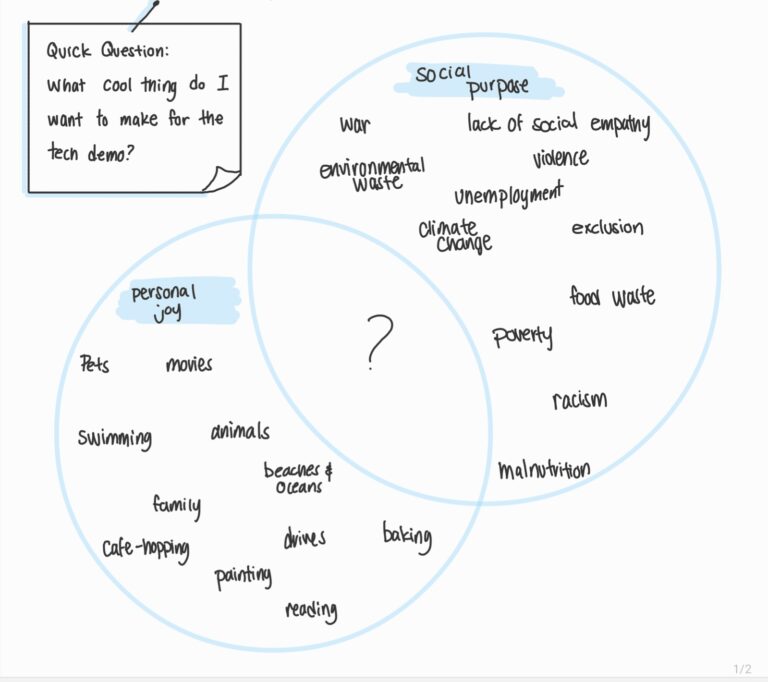
During this point of the class, we were working on a venn diagram activity to help us come up with ideas as shown in Figure 2. I was having a hard time finding connections between my personal joys and my societal purposes when it dawned on me. I realised that even when looking back at past projects, I have always had a close connection with bodies of water and what happens to and within them. In classes like DES 241- Designing with Mixed Realities and DES 233 – Design for Natural Environment, I had picked topics surrounding aquatic ecosystems and water in general.
So, I decided to utilise Adobe Aero to showcase some of the issues surrounding aquatic ecosystems, such as coral reef dying, reefs and sea beds being destroyed by deep fishing nets or something else along those lines. I would have to think and research more and also get some feedback before finalising my concept. Perhaps considering the applications and the use of United Nations Sustainable Development Goal 14 – Life Below Water as a starting point.
Summary
In summary, this week marked the start of an exciting yet demanding final year, as I will be trudging through my capstone papers. Reflecting on my skills and interests, I realise that while I may have some experience in some design tools, I still feel unprepared and unqualified to teach others because I believe most of my peer group possess the same skill set if not a better versions of my skills. This led me to choose Adobe Aero, a new skill I learnt last semester. Although I don’t feel qualified to teach it, I am willing to give it a try and I believe it will be an intriguing demonstration for my team. While developing and ideating with my classmates and also receiving some feedback from my lecturer, I refined my approach, to focus on readily available resources and to focus more on my personal interest and intrigue of aquatic ecosystems.
Action Plan
The next steps for me is to get feedback and also updating my Miro board as well as researching different issues we face in the aquatic ecosystems. There is always a chance that once I get feedback I might tweak some aspects of my project or fully change directions. However if I am given positive feedback I would then proceed with conceptualising and planning out how to effectively showcase personal joy and societal purpose and my research of aquatic ecosystems within my demonstration.
University of Edinburgh. (2024, October 15). Gibbs’ reflective cycle. Reflection Toolkit. https://reflection.ed.ac.uk/reflectors-toolkit/reflecting-on- experience/gibbs-reflective-cycle
Gibbs, G. (1988). Learning by doing: A guide to teaching and learning methods. Further Education Unit, Oxford Polytechnic.