After the tech demo this week has been significantly easier. Without the looming strain or the stress of the demo, I could now focus on other experiments that I was interested in. This week we were also introduced to a new reflective model.
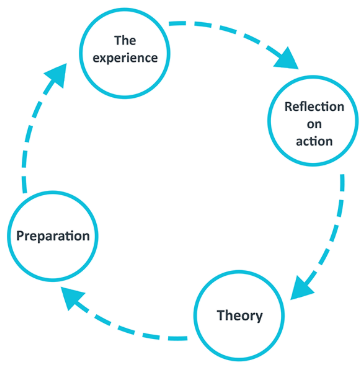
The new model that was introduced to us is called the Integrated Reflective Cycle (Bassot, 2013). This model while relatively similar to the Gibbs Cycle combines certain elements which allows for a free flowing and flexible reflection. The model is split into four steps. The Experience, the Reflection on Action, the Theory and the Preparation.
Over the course of this week I have been coming up with different concepts and idea of what I would like to experiment with and work on during this semester. So, I decided to sit down and using the brain storming we did in the first weeks to narrow my field of interests to fully encapsulate my core beliefs and interest so that my experiment can truly be something I am curious or fascinated by.
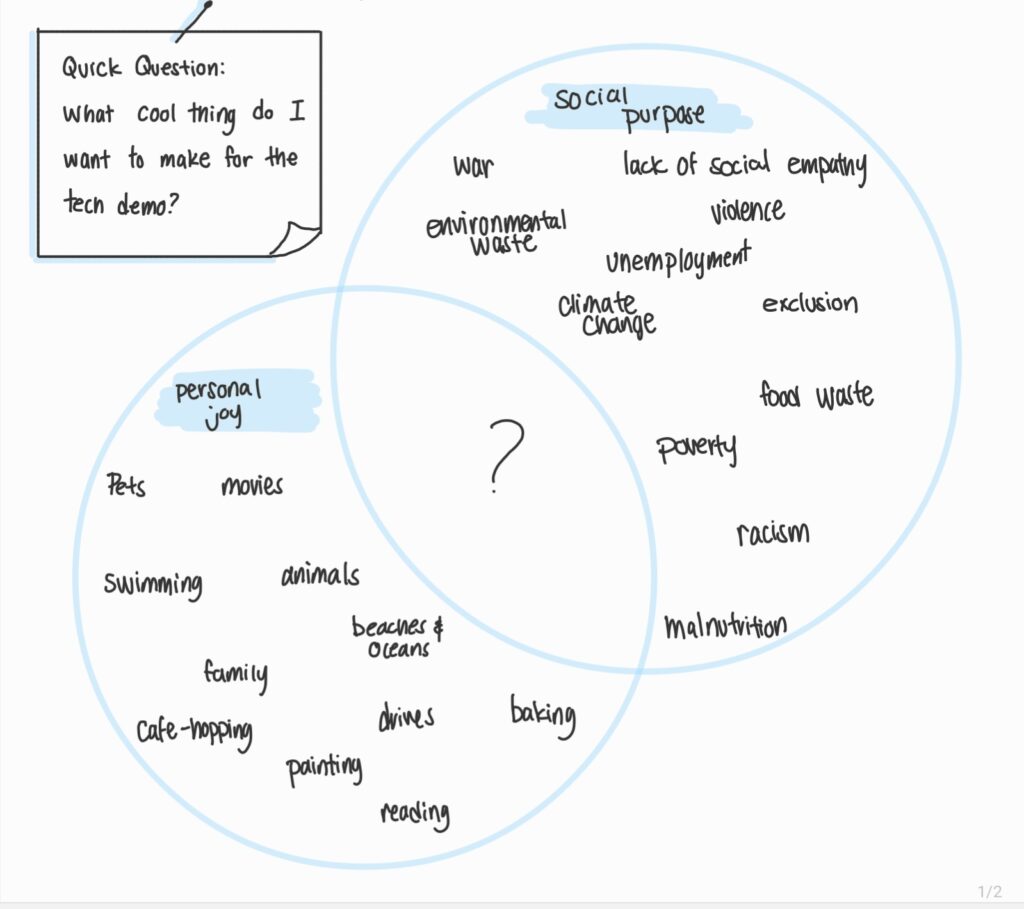
I kept thinking through all the potential topics and experiments and decided to use the sentence structure shown in class.
“I want to explore [focus] by [action] to better understand [goal]”
So I sat down and wrote many of these statements, 32 to be exact, but here are some of them that were not completely unattainable or absurd.
- I want to explore storytelling in UX by designing interactive experiences inspired by folklore to better understand how digital design can preserve cultural narratives.
- I want to explore gamification in recycling education by designing a web-based reward system for sorting waste correctly to better understand how interactive design can encourage real-life recycling habits.
- I want to explore localised recycling systems by mapping out the journey of my own weekly waste to better understand gaps or inefficiencies in my community’s recycling infrastructure.
- I want to explore biodegradable alternatives for fishing gear by prototyping net materials from natural fibres to better understand how ocean waste can be reduced at the source.
- I want to explore the voices of the sea by recording and layering underwater noises with different amounts of pollution within them to better understand how sensory art can showcase the unseen impacts of pollution.
Within all these potential experiments, I realised a theme of wanting to solve an issue I felt passionately about by creating a bridge or narrowing the gap between the known and the unknown about the topic.
Now onto the next big step which was to research different elements of my top 5 statements.
[I want to explore storytelling in UX by designing interactive experiences inspired by folklore to better understand how digital design can preserve cultural narratives]
Storytelling enhances UX by making the experience more emotional, memorable and personal. Instead of simply focusing on design, it pictures its users as characters and their pains as conflicts and the product as the solution to their problems.
Stories can be used in user journeys, testing scenarios and presentations to improve the understanding, create a stronger emotional impact and fosters empathy, this helps teams communicate better and for users to create a bond with the product (Aguayo, n.d.).
[I want to explore gamification in recycling education by designing a web-based reward system for sorting waste correctly to better understand how interactive design can encourage real-life recycling habits.]
Digital technologies like AI, IoT, blockchain, and digital platforms are fast tracking the cyclical economy by enabling smarter tracking, transparent supply chains, and material reuse. These tools are most effective in manufacturing, waste management, and consumer goods but they also face challenges like high costs, limited skills, and cultural resistance.
While there are promising examples such as smart bins and blockchain in fashion, more real-world case studies, impact measurement, and accessible solutions for small businesses are still needed to fully realize the potential (Venturi et al., 2025)
[I want to explore localised recycling systems by mapping out the journey of my own weekly waste to better understand gaps or inefficiencies in my community’s recycling infrastructure]
Urban recycling faces challenges like space limitations, high contamination rates, and expensive systems. Cities are tackling these issues with smart bins, simplified recycling, AI sorting robots, and public education campaigns. Success stories include Auckland’s improved bin labeling, Wellington’s community hubs, and Christchurch’s school programs. However, more coordination, investment in local facilities, and policies for recyclable packaging are needed. The key takeaway is that combining technology, education, and smart policies can significantly improve urban recycling (Campbell, n.d.).
[I want to explore biodegradable alternatives for fishing gear by prototyping net materials from natural fibres to better understand how ocean waste can be reduced at the source.]
Norway is testing biodegradable fishing gear made from plant-based materials and specially engineered plastics to reduce ocean plastic waste caused by lost or abandoned fishing gear. The goal is to create gear that is as strong and durable as traditional nets but decomposes in 2-5 years. Early prototypes show promise, but challenges remain in material strength and decomposition rates. If successful, this innovation could significantly reduce ocean pollution, protect marine life, and set a global standard for sustainable fishing, all while supporting Norway’s fishing industry. Further testing and scaling are needed (Responsible Seafood Advocate, 2025).
[I want to explore the voices of the sea by recording and layering underwater noises with different amounts of pollution within them to better understand how sensory art can showcase the unseen impacts of pollution.]
Research in Calder Haven highlights the impact of underwater noise pollution from shipping and industrial activities on marine life and coastal communities. The constant low-frequency noise disrupts marine mammal communication, alters fish behavior, and leads to habitat avoidance in harbor porpoises. Community members report changes in their coastal sensory experience, and ecological stress responses are observed across species. Proposed solutions include voluntary slow-down zones for ships, engine quieting technologies, and marine spatial planning to protect habitats. This research emphasizes the significant, yet often overlooked, role of underwater noise pollution (Lalonde, 2022).
Now the big issue came that I simply could not pick between the several options even with al the research I had done and knowing that I had the crit and advice session coming up in the following lecture I decided to ask my peers and tutors for feedback and opinions to see if that could help me come to a better conclusion.
References:
Aguayo. (n.d.). Storytelling in UX: How to design engaging narrative experiences. Aguayo UX & Technology. https://aguayo.co/en/blog-aguayo-user-experience/storytelling-in-ux/
Bassot, B. (2013). The Integrated Reflective Cycle. University of Edinburgh. https://reflection.ed.ac.uk/reflectors-toolkit/reflecting-on-experience/the-integrated-reflective-cycle
Campbell, O. (n.d.). Overcoming urban recycling challenges: Solutions for cities. Sustainable Living. https://sustainableliving.org.nz/overcoming-urban-recycling-challenges-solutions-for-cities/
Lalonde, C. (2022, June). Strained listening: Sensing underwater noise pollution in Calder Harben’s ‘Bodies of Water’. Burlington Contemporary. https://contemporary.burlington.org.uk/journal/journal/strained-listening-sensing-underwater-noise-pollution-in-calder-harbens-bodies-of-water
Responsible Seafood Advocate. (2025, February 24). Scientists in Norway explore biodegradable fishing gear to tackle plastic pollution in the ocean. Global Seafood Alliance. https://www.globalseafood.org/advocate/scientists-in-norway-explore-biodegradable-fishing-gear-to-tackle-plastic-pollution-in-the-ocean/
Venturi, S., Zulauf, K., Cuel, R., & Wagner, R. (2025). Trash to treasure: Gamification and informed recycling behavior. Resources, Conservation and Recycling, 215, 108108. https://doi.org/10.1016/j.resconrec.2024.108108